

02/04/2026 | Reading Time: 3 mins | Categories: Aged Care in home / Blog / Community / Evidence / GPs / Health Professionals / Implementation and Translation / Nurses / Patients and Carers / Primary health care / Specialist Palliative Care
People living with advanced cancer now have more treatment options than ever before. At the same time, cancer treatment has become increasingly complex. Many new treatments only offer relatively small improvements in survival, often around two to three months on average. [1] When treatments cannot cure cancer but may extend life or improve symptoms, it becomes especially important to weigh these potential benefits against the downsides of treatment.
One downside that has received growing attention is the time required for treatment. This has been described as a hidden side-effect of treatment, using the term “time toxicity”, and for good reason. [2] Research suggests that people with advanced cancer may spend up to a third of their remaining life on treatment-related activities. For some, this means that travelling to and from hospital, attending appointments, undergoing tests, receiving treatment, and recovering afterwards can take the place of time spent on hobbies, with loved ones, or on holidays. [3] When time is limited, time spent receiving healthcare can come at the cost of things that matter deeply.
Several research groups, including our own, have spoken directly with people receiving treatment for advanced cancer, as well as their caregivers, about their experiences of treatment-related time. These interviews show that time spent on treatment can place a significant burden on both patients and families. [4-6] For some, but not all, long days at hospital, frequent appointments, fatigue, and disruption to daily routines can take an enormous toll. What we do not yet understand well is how knowing about these time demands influences people’s treatment choices, particularly when more than one reasonable option exists.
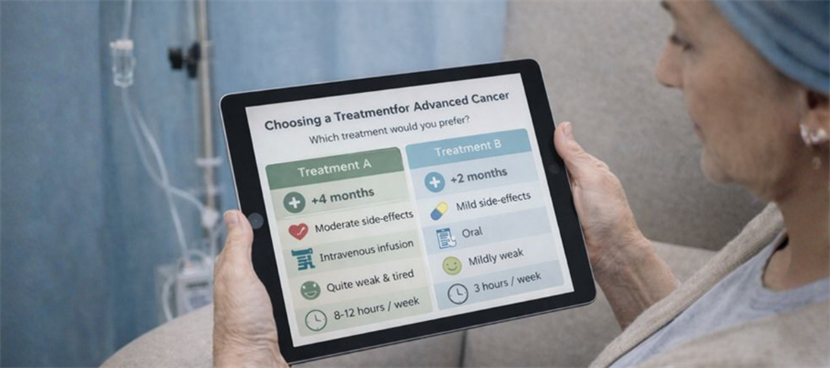
To explore this, we set out to design a study known as a discrete choice experiment. This type of study helps researchers understand what people value by asking them to choose between hypothetical treatment options, each with different benefits and drawbacks. Before doing this, we needed to be confident that we were asking about the things that matter most.
We began by interviewing people living with advanced gastrointestinal cancers, their caregivers, and oncologists, to understand the factors shaping real-world treatment decisions. We also reviewed the scientific literature to identify other influences on how people choose treatments.
A clear message emerged: treatment decisions are rarely about survival alone. [7] People described weighing possible survival gains against side-effects, impacts on physical functioning, and practical considerations such as time spent in hospital, fatigue, disruption to everyday life, and time away from family. For some, even a small extension of life was worth the burden of treatment. For others, protecting time at home, time that still felt meaningful, mattered more. How treatment was given, how often hospital visits were required, and how long treatment was expected to continue were also important considerations. These themes were consistent with findings from other published studies.
These insights helped us identify the key factors or “attributes”, for our upcoming discrete choice experiment (DCE). These include impact on survival, side-effects, physical functioning, how treatment is given, the amount of time involved, and the planned duration of treatment.
Our study, the TIME-DCE, is now recruiting participants from 10 hospital sites across NSW and the ACT. We aim to understand how people with advanced cancer weigh these factors in realistic hypothetical scenarios, and to compare their views with those of people of similar age and gender from the general Australian population.
Understanding the importance of treatment-related time matters because it challenges how treatment decisions are often discussed. Conversations frequently focus on whether a treatment “works” biologically, rather than whether it fits within a person’s values, goals, and circumstances. Unlike potential benefits or side-effects, the time required for treatment is often more predictable, and this knowledge can offer patients a sense of control over their time in an otherwise uncertain situation.
By making the time costs of treatment more visible, we hope to support more informed and meaningful decision-making. Ultimately, the goal is simple: to shift conversations from “What can we offer?” to “What matters to you?” When treatment decisions reflect what people value, including how they wish to spend their time, care becomes not only effective, but truly humane.
Further reading
To know more about the time toxicity of cancer treatment, read: https://ascopubs.org/doi/10.1200/JCO.21.02810
Image credit: ChatGPT
Author

Dr. Samuel Stevens, MBBS (Hons) B App Sc M Bioethics FRACP
Medical Oncologist & PhD Candidate, The University of Sydney, Australia
Tags: Advanced Cancer / End of life care / Palliative Care / Quality of Life / TIME DCE / Time Toxicity / Treatment Decisions
307 views
The views and opinions expressed in Palliative Perspectives are those of the authors and are not necessarily supported by CareSearch, Flinders University and/or the Australian Government Department of Health, Disability and Ageing.