What is a ‘good death’?
An article written by Shanna Provost for the Good Death Impact Network, funeral celebrant, specialist educator in end-of-life issues, and a death midwife
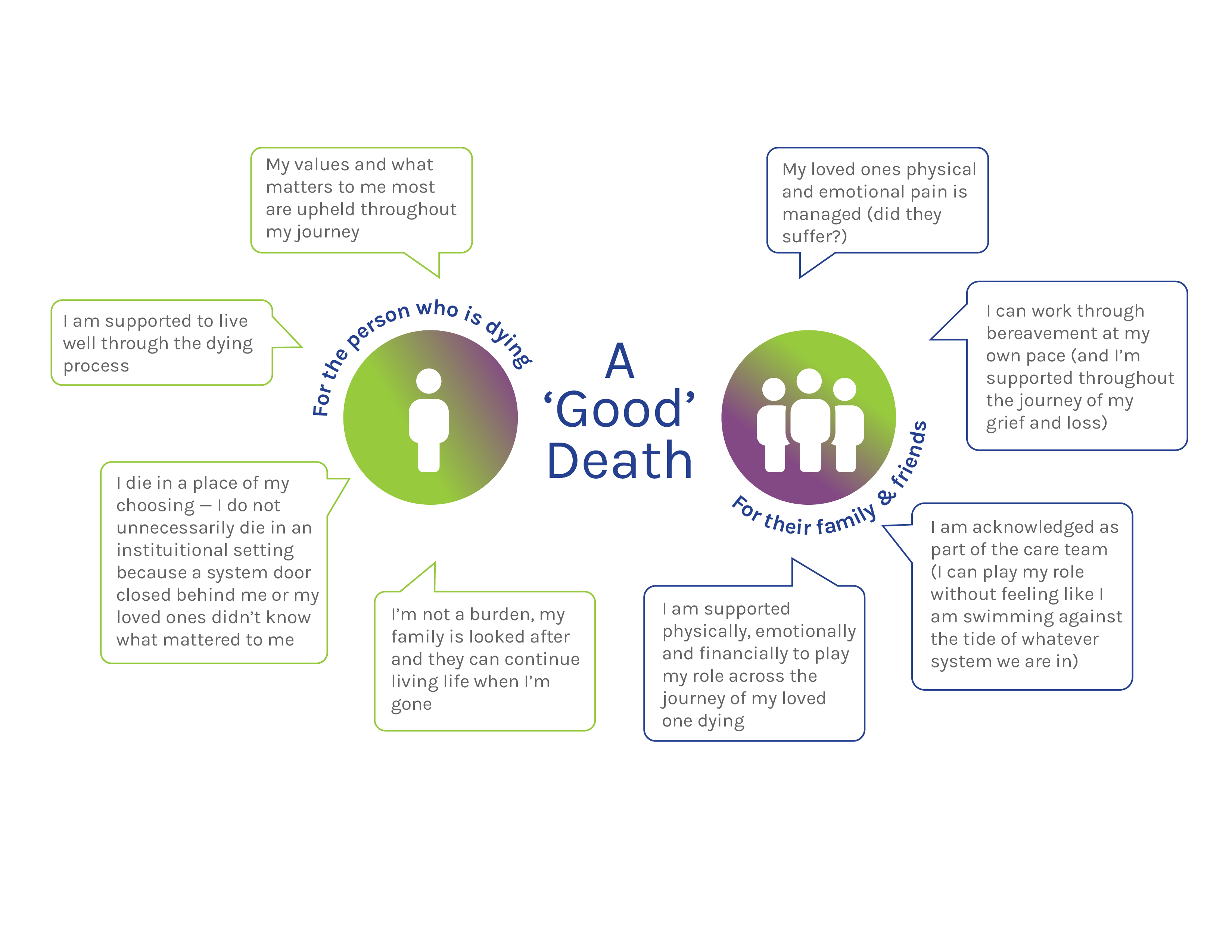
At the Good Death Impact Network (GDIN), our members work across every part of death, dying and grief, and they encounter consistent themes: dignity, comfort, no suffering, pain relief, understanding what is happening, a sense of control or someone to advocate for their wishes, companionship and community, clear communication, being with the right people in the preferred environment, cultural and spiritual wishes honoured, and support for those they leave behind. It’s important to note however, that some cultures do not openly talk about death and dying and do not wish for people to be told they are dying, but it’s equally important not to make assumptions based on a person’s culture.
Supporting this, a 2021 systemic review in The Lancet found that a good death includes ‘autonomous treatment decision-making, avoiding futile life-prolonging interventions, and not being a burden to others.’ It also highlighted that the legal right to end one’s life can influence a person’s sense of control during the final stages of life. [1]
Across our network, many perspectives comingle, but when we asked our members what a ‘good death’ is, the picture became more nuanced.
Danni Petkovic, death doula and National Dying to Know Day (D2KD) Campaign Manager, avoids framing death as ‘good’ or ’bad’. Instead, she focuses on alignment with a person’s values. “It is not a moment; it’s a continuum of care, honesty, and human connection that reflects who you are; a death shaped by values, not by circumstances.” After supporting hundreds of D2KD community events, she felt the consensus on a good death was, “One where a person is known, heard and supported; where their choices are honoured, their suffering is eased, their community is present, and their final days reflect the truth of who they are. It’s not perfect or painless, but it is human, connected, and theirs.”
A comfortable and safe setting is essential. Jan McGregor from Pure Land Home Hospice explains, “While it is commonly said that most people want to die at home, there are those who feel safe, comfortable and cared for in a more clinical setting such as a hospital, where their loved ones are free to do nothing other than sit with them and give them their full attention.”
Other members question whether the term ‘good death’ is useful. Bec Lyons, Independent Funeral Director and Board President of the Australian Home Funeral Alliance notes, “The notion of a ‘good’ death is misleading because it positions some as bad deaths.” For her, a good death is “an informed one; achieved with intentionality and compassion, where the dying person has agency to put thought and consideration into their end and make meaningful choices, and has conversations with their people so they felt empowered to carry out those wishes.”
Joe Sehee, Executive Director of Social Health Australia, highlights the role of connection: “Finding common humanity in death can allow it to move beyond being a personal tragedy. We experience it differently when we know that others are having to deal with the same thing.” He recalls observing this whilst companioning a woman who felt at peace when her family normalised dying by discussing in her presence who in the family ‘would go next’.
For adult children a good death often centres around clarity. Michelle Chaperon, creator of Carers’ Circle, says it meant knowing her parents’ wishes and enacting them with love. For her, a good death “creates space for stories, laughter, and tears, allowing us to honour them fully and authentically while supporting each other in our grief. It would be free from uncertainty because their choices were openly discussed.”
Across these perspectives, one thing is clear: there is no single template for a good death. What matters is agency, communication, connection, and the ability to be cared for in ways that honour the wishes of the person who is dying.
It is also important to recognise that not all deaths come with warning. That’s why many of our members focus on education and helping people plan for death. For me, I don’t think in terms of a ‘good’ death, but of a ‘graceful’ death. This means taking the time to put affairs in order and discussing everything with loved ones so they can navigate whatever comes. Having done this, one can die with grace, no matter the circumstances.
At GDIN, we invite everyone to reflect on what a good death is: not to achieve a perfect death, but to make space for honesty, planning and care.
- Zaman M, Espinal-Arango S, Mohapatra A, Jadad AR. What would it take to die well? A systematic review of systematic reviews on the conditions for a good death. The Lancet Healthy Longevity. 2021;2(9):e593-e600.
- Learn more about the Good Death Impact Network, their work and resources, by visiting https://www.gdin.com.au
Author
Shanna Provost
Funeral celebrant, specialist educator in end-of-life issues, and a death midwife
The Good Death Impact Network